
- Procedure time
- About 3½ hoursOperative time
- Anesthesia
- IV sedationNo breathing tube
- Setting
- Our procedure suiteHome the same day
- Downtime
- About two weeksLonger if you are client-facing
- Results last
- Seven to ten yearsVaries with age and lifestyle
The layer that matters
The facial muscles coalesce into a single fibrous layer — the SMAS. Beneath it sits the deep plane, and running through that plane are the retaining ligaments that anchor the face to the structures underneath.
Aging is largely those ligaments allowing descent. So the question a facelift has to answer is simple: are you going to release what is holding the tissue down and move it back, or are you going to tighten over the top of it and take out skin?
I work under the ligamentous layer, so the tissues that actually fell with age are the tissues that get lifted.
Both operations are legitimate and both are done by good surgeons. If you want the longer version of the comparison, I have written up what actually differs between a deep plane and a SMAS lift on facelove.info, the reference library this practice publishes.
Why it tends to hold, and why it tends to look like you
When the lift comes from repositioned deep tissue, the skin is not the thing under tension. It is simply redraped over a structure that has been put back where it was. That is the mechanical reason a deep plane result generally reads as more natural, and why it tends to be more durable than a technique that relies on pulling skin.
It also changes the risk profile of the operation. Tension on skin is what widens and migrates scars over time. And because the deep plane is largely avascular, dissecting in it is associated with less bleeding. That matters, because hematoma is the most common early complication in facelift surgery.
The nerves are the whole discipline
The branches of the facial nerve that move your face run in the deep plane. Operating in that plane means operating where those nerves are, and protecting them is the technical core of the procedure.
This is the argument for choosing a surgeon by anatomy. I’m dual board-certified by the American Board of Facial Plastic and Reconstructive Surgery and the American Board of Otolaryngology — Head and Neck Surgery. That second one is the specialty of the head and neck itself: the nerves, the planes, and what to do when anatomy is not textbook.
Whether it’s your operation
Two different things happen to a face over time, and they need different answers. Tissue descends. That is a lifting problem. Tissue deflates, which is a volume problem, and lifting will not fix it. Fat transfer addresses the second.
Most faces are a mix, in a proportion specific to that face. Working out which of your concerns is descent and which is deflation is what determines whether this is the right operation for you.
There is a shortcut, and most patients arrive already performing it. At the mirror you put your fingers along the cheek or the jaw and lift — upward, or upward and back — and you like what you see. Or you take hold of the loose skin under the chin and show me what you would want gone.
That gesture is diagnostic. It tells me what bothers you and the direction of pull that fixes it, in one motion.
What the gesture demonstrates is descent, because a lift is the only thing a pair of fingers can simulate. Deflation stays exactly where it is. So when I put your hands down and my hands on your face, I am largely sorting the part of your concern that moved from the part that emptied.
What tends to point here
- A fold forming just outside the nasolabial fold, sometimes with a slight hollow between it and the cheek
- Loss of definition along the jawline
- Loose skin under the chin, vertical banding of the platysma, or fullness in the neck
- A face in the mirror that looks older than you feel
None of that is an age question. Two people the same age can need entirely different operations, which is why this is settled with hands on tissue rather than from a photograph or a phone call.
Where the incisions go
Three, each placed in anatomy that hides it.
Under the chin
A submental incision, three centimeters or less, in the natural crease most people already have. Through it I lift the skin off the muscle and assess the fat and muscle layers directly. In most cases I trim the platysma and suture the edges into a sling, anchored laterally to the mastoid bone. That sling is what gives the neck its durability. Where there is fat beneath the muscle, it is addressed through the same opening.
Around and behind the ear
The incision comes up along the earlobe, passes behind the tragus, follows the auricular attachment, and continues into the hairline. Behind the ear it hides in the sulcus with a short limb, a centimeter or less, into the hair.
I deliberately avoid an incision running down the hairline. In patients with a lot of loose skin that choice can leave slight bunching behind the ear, visible only on close inspection and usually settling with time. I consider that a fair trade for not leaving a visible line along the hair.
The exact technique is decided during surgery, not before it. I have a very good idea from the examination of what I am likely to do. I do not know for certain until I can see the layers.
What your consultation looks like
No presentation, no room full of coordinators. A conversation, an examination, and a plan you watch being made in a handheld mirror.
Paperwork and history
Medical history and a privacy acknowledgment when you arrive. Nothing about surgery is signed until we have agreed on a plan.
Time with Maria
Maria Moreno, our Patient Care Coordinator, meets you first. She asks what brings you in, clarifies your forms, and takes a standardized set of six-view photographs. I review those before I walk in, so I arrive already oriented.
“So — what bothers you?”
That is how I open. Most people answer with their hands, which is more useful than a list of procedure names.
The examination
Gloves on. I examine you from the side and put my hands on your neck, feeling for skin laxity, laxity of the platysma, the amount of fat beneath it, and the position of the submandibular glands. Then I take up the skin along the neckline toward the back of the ear to judge how much needs to come out, and work upward to the jawline and midface, testing which direction of lift improves each.
You watch it happen
You hold the mirror throughout. As I demonstrate each vector, you see what I see — where the fold softens, how the jawline changes, exactly where every incision will sit. Nothing about the plan should be abstract by the time you leave.
The plan, and an honest number
What I recommend, what it involves, and the risks that come with it. I err conservative on results and tell people to anticipate somewhere around 70 to 80 percent improvement. I would rather beat that number than defend one.
Clearance, pricing, scheduling
We decide whether you need medical clearance beforehand — routine at 70 and older, sometimes advisable earlier. Maria then reviews pricing and scheduling with you directly. Fees are quoted once we know what we are actually doing, and CareCredit financing is available.
Asleep, but not under
Your procedure is done in our own procedure suite with a CRNA who has been with this practice for years and is very good at keeping people comfortable.
We use IV sedation, typically midazolam and propofol. No general anesthetic, no endotracheal tube, no inhalational gases. If you have had a colonoscopy, it is the same class of anesthesia, and most people find that comparison settles the question faster than anything else I can say.
In my experience that approach means less nausea afterward and fewer swings in blood pressure during the case. The second one matters more than it sounds: blood pressure spikes are tied directly to the complication I worry about most.
People ask whether they will wake up during surgery. You will not. The anesthesia is not turned off until the operation is finished.
Afterward we watch you for an hour or two, give you something to eat, and empty the drain so we have an accurate count of its output. You are wrapped firmly for the first night and you go home the same day.
Recovery, honestly
This is my actual post-operative protocol, day by day, including the parts nobody enjoys reading. Recovery is easier when you know in advance what is supposed to happen. The single most common call we get is from a patient on day three who thinks something has gone wrong.
Day 1
First post-op visit- We remove the compression wrap, evaluate the incisions and bruising, empty your drain, and put you into a compression garment.
- Head elevated at 45°. Pain medication on a schedule, not when the pain hits.
- Don't look in the mirror more than once. Trust me on this one.
Day 3
Second post-op visit- Bruising peaks. This is the day patients call worried that something has gone wrong. Nothing has gone wrong — you are healing exactly on schedule.
- Garment off, incisions cleaned, drain removed if the output is minimal, garment back on.
Day 10
Third post-op visit- Sutures come out, around the ears and under the chin.
- You start gently massaging the face and neck with a firm foam roller to even out the swelling.
- Antibiotic ointment switches to silicone scar gel.
Day 14
- Most of what a stranger would notice is gone. Concealer covers the rest.
- Quiet activity is fine. Driving, working from home.
- Still no exercise, swimming, or long flights.
Week 3
- The major swelling drops and your new face starts to emerge.
- Light exercise is fine. Most patients are back to office work.
Week 6
Formal photographs- We take your formal post-operative photographs at this visit.
- Comfortable on camera without makeup. Full exercise cleared, sauna included.
- This is roughly 90% of your result. The last 10% takes about four more months.
Month 3–6
- Final settling. Scars mature from pink toward flesh tone.
- For most patients, the face you have at month six is the face you will have for the next seven to ten years.
- If you are not happy at month six, tell us. That conversation is part of the care, not an imposition on it.
The three mistakes that cost people the most
- 01
Rushing back to work
The face needs two real weeks. Not two weeks of checking email from bed — two weeks.
- 02
Skipping head elevation
Sleeping flat means more swelling, and more swelling means a longer recovery. The 45° rule is not a suggestion.
- 03
Sun exposure too early
Even ten minutes on a healing scar can leave a permanently darker mark. This one you cannot undo.
You will look in the mirror in the first day or two and ask what on earth you did to yourself. So you are allowed to be furious with me. Just not until two weeks have passed.
By two weeks almost everyone has come round. What felt alarmingly tight on day three reads as normal, and patients tell me they realize it was not too tight after all — it was where it needed to be. Two weeks is also when most people are what we call restaurant ready: out to dinner, nobody asking what you have had done.
There is usually little real pain. Some people read the tightness as soreness, so you go home with the option of a narcotic, but a great many patients manage on Tylenol. A short course of steroids helps with the bruising and swelling.
Between visits we are reachable by phone, email or text. If something worries you, send a photograph. I would much rather look at something at nine in the evening than have you spend the night wondering.
What can go wrong
This is surgery and surgery carries risk. These are manageable risks, but you should hear them plainly while you are deciding, not on a consent form the morning of your procedure.
Hematoma — the one I worry about
A collection of blood under the skin or the deeper tissues. Even when it happens it is usually manageable. It does extend recovery, it is a genuine nuisance for both of us, and a large one putting tension on an incision can affect how that scar finally heals. It also raises the chance of needing a touch-up later.
How we guard against itDetailed instruction on medications to avoid before and after; restrictions on exercise, alcohol and anything that drives heart rate or blood pressure up; careful cauterization of vessels during surgery; a drain for about three days; and in some cases hemostatic netting sutures to close the space where blood could collect. Your day-one visit exists to catch it early, because if it happens it nearly always happens in the first twenty-four hours.Numbness
Everyone gets this. The small nerve endings supplying the skin are necessarily divided where we undermine, and they need time to regenerate. Expect six to nine months, sometimes longer, and in some people sensation never returns entirely to what it was.
Infection
Uncommon in facial surgery, where the blood supply is generous. The procedure is done under sterile conditions with a short course of prophylactic antibiotics.
Difficult healing and scarring
Some people heal slowly and some are prone to wide or hypertrophic scars. Your particular risk factors are something we go through at consultation. Where a scar does need revising we wait at least six months, often closer to a year, before going back.
Needing a touch-up
Occasionally a result warrants refinement. If I anticipate that, I will say so at your six-month visit, and we would plan it around a year from the original operation once the tissues have fully settled.
How long it holds
In your fifties, a deep plane face and neck lift generally gives a good seven to ten years, sometimes longer. In your sixties, closer to five to seven. Beyond that I am reluctant to promise a figure, though the same five-to-seven range is reasonable.
Those numbers move with how you age, and aging is not evenly distributed. Sun exposure, smoking, weight fluctuation and general health all change how the tissues behave, which means a real part of how long your result lasts is in your hands as much as mine.
What the operation does not do is stop the clock. It resets your starting point. You go on aging from there, just from a better place than you would have.
If you would be happy with eighty percent improvement, you are going to be very happy. I would far rather set that number and beat it than promise perfection and spend a year explaining myself.
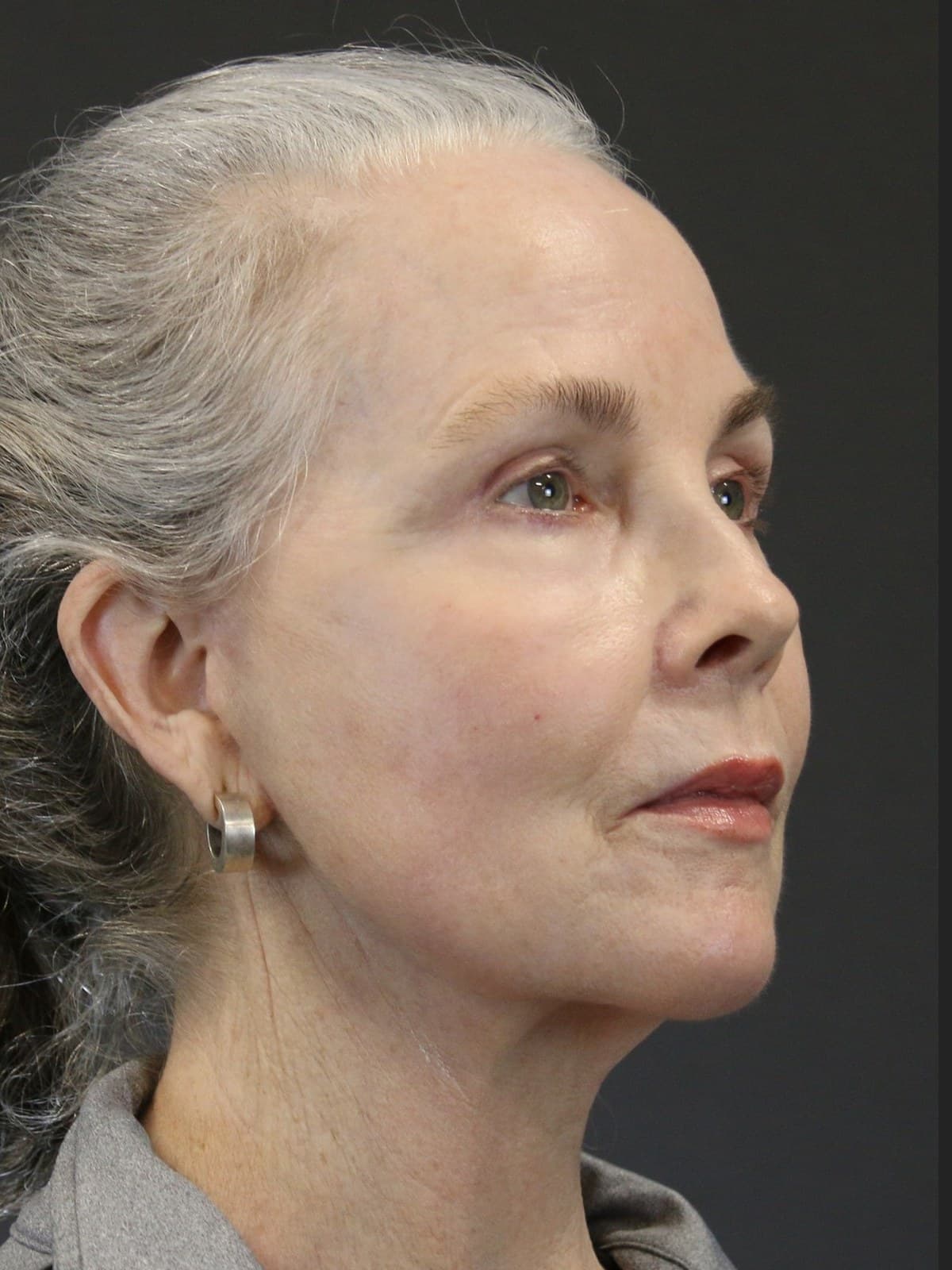
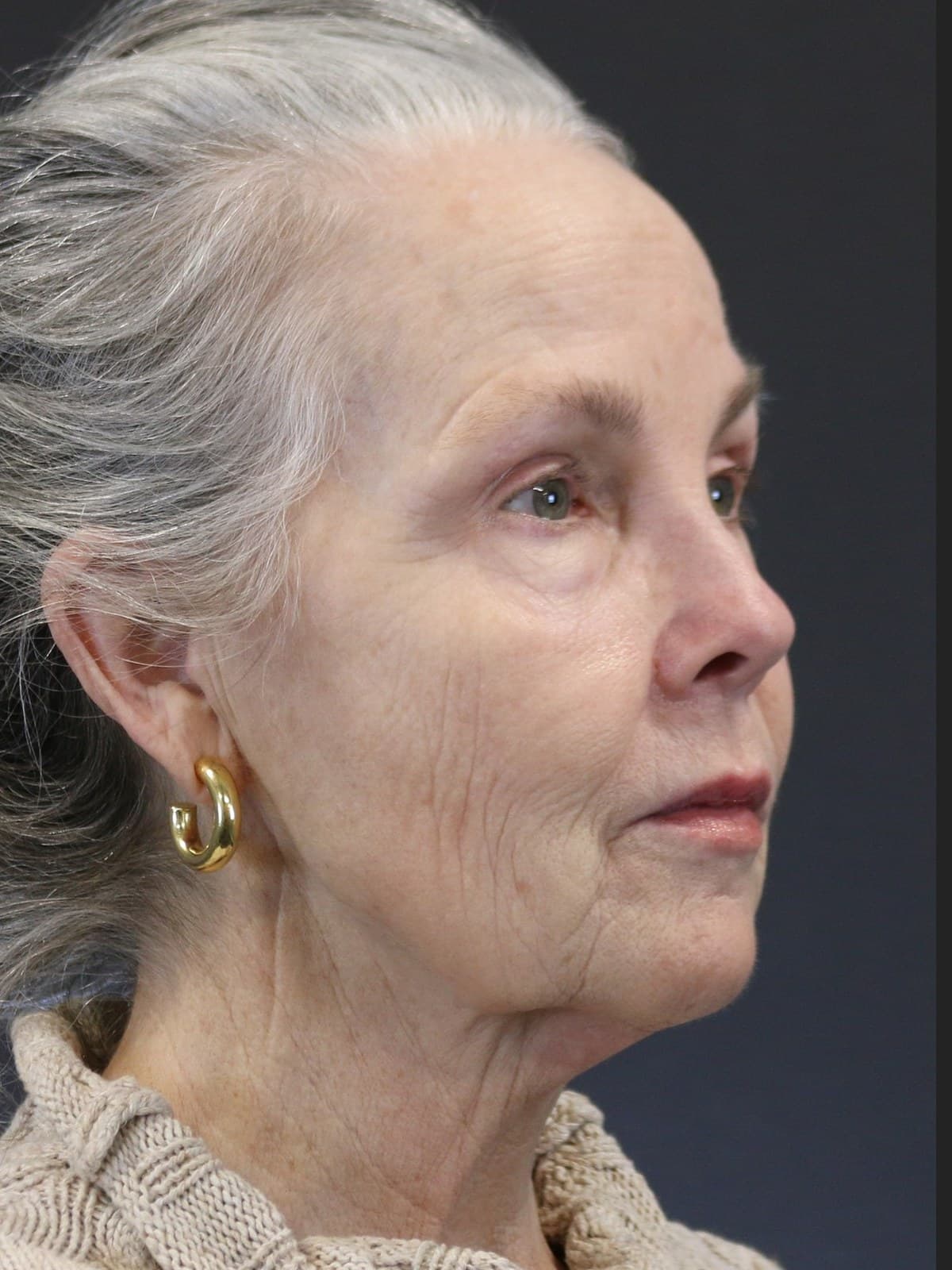
Results
Before-and-after photographs of Dr. Keni’s deep plane facelift patients, at consistent angles and lighting.
Individual results may vary. The photographs shown are of actual patients of Dr. Keni who have consented to their use.
Common questions
- How is a deep plane facelift different from a traditional facelift?
- A traditional facelift tightens the SMAS layer from above and relies heavily on removing skin. A deep plane facelift works underneath that layer, releasing the retaining ligaments so the tissue itself can be repositioned. The skin is then redraped, not pulled. That is why the result tends to read as restored.
- Does a deep plane facelift look natural?
- The technique is designed around that question. The lift comes from repositioning deeper tissue, so the skin is not carrying the load. Tension on skin is what produces the pulled look and the widened scars people associate with facelifts.
- What about the facial nerves?
- The facial motor nerves run in the deep plane, so nerve preservation is the central technical discipline of the operation. I'm dual board-certified in facial plastic surgery and in otolaryngology — head and neck surgery, which is the anatomy this operation lives in.
- Is the deep plane facelift the right operation for me?
- It depends on whether your concern is descent or deflation. Tissue that has fallen is a lifting problem. Volume that has been lost is not, and is better addressed with fat transfer. Most faces are some of both, and sorting out which is which is what the consultation is for.
- Can it be combined with a neck lift?
- Frequently. The face and neck age as one unit, and addressing the face alone can make an untreated neck more obvious. Whether they are done together is discussed at consultation.
- How long is recovery from a deep plane facelift?
- Plan on two real weeks away from work. Bruising peaks around day three, sutures come out at day ten, and by day fourteen most of what a stranger would notice is gone. At six weeks you have roughly 90% of your result; the last 10% settles over about four more months.
- When will I look like myself again?
- Around week three the major swelling drops and the new face starts to emerge. Week six is when we take your formal photographs. Final settling, including scars maturing from pink toward flesh tone, continues through months three to six.
Not sure this is your problem? Jowls and a softening jawline
Financing available through CareCredit. See financing options